Rapid Assistance Dog Team
The RAD team is in the process of development. This page covers the basics of the concept and development process of the pack
A New Wolf Conflict Tool in the Making: The Rapid Assistance Dog Team
Across the American West and around the world, wolves and livestock are increasingly
sharing landscapes. And it’s often not going well. While many people celebrate the return
of a keystone predator, ranchers face the real and immediate challenges of protecting their
herds. Traditional tools often fall short, and lethal control measures, while sometimes
necessary, often deepen divides between rural and urban communities.
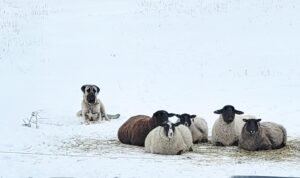
But what if livestock guardian dogs (LGDs), whose successful partnership with shepherds
dates back to the Middle Ages, could it be deployed in a new way?
A team of researchers, ranchers, LGD breeders, and wildlife conflict specialists is working
to test an idea through a proposed pilot project called the “Rapid Assistance Dog Team
(RAD Team)”. The project’s ultimate goal: to create a highly trained, mobile group of
guardian dogs and handlers who can be deployed to livestock–predator conflict “hot
spots,” offering producers non-lethal support when they need it most.
Experts at Colorado State University called the concept “a potential game changer.”
The tool would not be applicable to all wolf conflict situations, and is no silver bullet
overall. However, the project could potentially create a new non-lethal technique for
predator/livestock conflict, bridging divides, saving livestock, and giving wolves a chance
to stay wild.
The RAD Team concept is a pilot project to develop and test a mobile, rapid-response group
of livestock guardian dogs (LGDs) and handlers. These highly trained dogs would travel by
truck, trailer, or even small aircraft to ranches experiencing ongoing wolf/livestock
conflicts. Their role: create a biofence of scent, sound, and physical presence to deter
wolves and protect livestock. The intention is not to engage directly. Using advanced
“virtual fence” collars and GPS tracking, the dogs would patrol and scent-mark perimeters
around threatened herds, barking strategically to signal their presence at various
waypoints.
Wolf/livestock conflicts are on the rise across North America and Europe as wolf populations expand or are reintroduced. Many ranchers have mixed experience using nonlethal tools effectively, and the development of new tools and techniques hasn’t kept pace with the need.
Livestock guardian dogs are one of the oldest and most effective non-lethal deterrents, yet they’re underused. Why? Raising and training LGDs takes time, money, and expertise. Many producers also worry about liability issues if their dogs interact with the public or wildlife.
The RAD Team would make LGDs accessible where and when they’re needed most without requiring ranchers to raise their own. And if someone was keenly interested in purchasing LGDs, this would also give the ability to test LGDs on their operation before investing.
A team is currently in formulation, and could be comprised of an impressive coalition of
collaborators, all in Colorado:
Colorado State University (CSU) – particularly CSU Extension and the Center for Human Carnivore Coexistence, along with unaffiliated faculty and researchers.
The Stanko Family Ranch – fifth-generation Colorado ranchers and leading LGD breeders with strong ties to the agriculture community.
USDA Wildlife Services – offering technical support, expertise, and potential funding, already developing smart LGD collars that track behavior and location.
Wild Ranch (wildranch.org) – a nonprofit effort aimed at channeling urban support for ranchers on the front lines innovating new non-lethal deterrent systems using LGDs, AI camera traps and auto-deterrents, GPS livestock tracking and behavior sensors, and custom range-rider apps to better predict and prevent livestock attacks in the making.
The first phase of the project will try to show that LGDs can be trained to patrol a route
where they are not interacting with livestock. We know that LGDs that are traditionally
bonded to livestock will still follow their handlers away from their companion animals for a
hike or to follow an ATV to a new location, etc. We will attempt to show that they can be
taken to a new ranch (with no wolves) and follow a planned route without issue. People,
livestock, horses, and wildlife would all be distractions that would need to be ignored by
the LGDs, who would have been previously habituated to those situations.
This approach introduces a type of biofence, primarily of scent and sound, that the team believes could alter wolf behavior in some cases without physical confrontation.
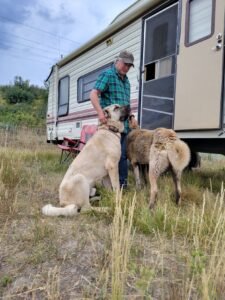
For example, over four years, the Stankos stationed LGDs alongside their camper at the start of calving season in an area where coyotes had become bold, moving through the herd to access a river, and often took the first calf born. After placing the dogs within an electric fence for protection, they began barking whenever they detected coyotes. This allowed the Stankos to step in before a loss actually occurred. Since then, the coyotes’
behavior has changed, and the Stanko have had no further losses.
This experience showed how, without direct interaction, properly trained LGDs can disrupt a predator’s patterns and protect livestock. Then Stankos further tested the idea in 2025 by taking the dogs to a summer pasture, which was unfamiliar ground to the LGD’s, and again penned them up in an electric corral next to the travel trailer which the cattle were not used to as well. After two nights on the property, the LGD’s barking presence stopped
coyotes from pressuring the herd. This doesn’t prove the RAD Team concept, but it gives hope that similar results could perhaps be achieved with wolves in some situations, especially with added training and patrol/marking/barking techniques, and with a combination of novel deterrents.
The team envisions a three-year pilot project (LGDs take two years to mature into efficient working dogs and a third year to adjust/understand pack dynamics and develop confidence needed for reliable field work
Year 1: Select and train puppies, making sure they are comfortable in many different situations with a variety of strange livestock, adults and children, bikers, horseback riders, vehicles, ATVs, and other dogs. Begin designing monitoring/tracking/training systems.
Year 2: Continue training in diverse situations. Test virtual fencing, smart tracking collars, and patrol route training techniques to manage scent marking and barking. Reward and condition LGDs to different modes of travel. Deploy to test sites with livestock (but no wolves).
Year 3: Continue training at test sites with unfamiliar livestock herds (no wolves), then cautiously assist as deemed appropriate, perhaps starting in real conflict zones outside Colorado, where wolves are not federally protected.
At each stage, researchers will evaluate costs, effectiveness, animal behavior outcomes,
and LGD welfare considerations.
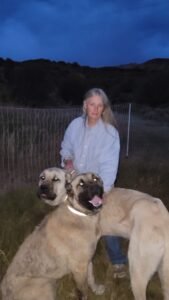
The RAD Team will be built from individually selected pups chosen for their balanced temperaments and working potential rather than breed alone. Ideal candidates will show low “prey drive”, be confident but not dominant, and demonstrate calm, stock-safe behavior.
During early training, dogs must show the ability to think through situations, tolerate or ignore non-threats, and respond appropriately to handler direction. The goal is to develop brave, thoughtful, cooperative dogs that can work effectively within a pack and adapt to
changing environments while maintaining focus on protecting livestock.
In a conflict hot spot, such as counties that have declared wolf-related emergencies, the RAD team would deploy only after a thorough site assessment and briefing/strategy meetings with all stakeholders. There are situations where the likelihood of physical contact between dogs and wolves would be too high, for example, near a den, and there are others where the risks would be lower. The dogs’ safety is paramount. Protocols would be developed that “tested the waters”, and the LGD handlers would assess the risks, be present with the dogs at all times, and gradually, if appropriate, let the dogs patrol on their own, or perhaps stay in an electric corral. All these non-conflict strategies and ideas need more thorough development and evaluation by subject-matter experts, along with feedback from field testing. Developing field assessment techniques and criteria to avoid direct conflict will be a key consideration during the pilot project.
The number of dogs would always need to exceed the number of wolves in the area.
The RAD team will be trained to ignore dogs when travelling oƯ their own ranch. However, existing ranch dogs at hot spots would be removed temporarily to prevent potential dog-to-dog conflicts that could be driven by confusion if the LGDs perceive other dogs as a threat to the livestock.
The RAD Team’s strategy is to “influence wolf behavior indirectly”, through presence, scent, and sound not contact. This gives producers time to make measured management decisions: moving herds, adjusting deterrents, or working with agencies to find long-term solutions.
A combination of LGDs with an assortment of other non-lethal tools could create a paired negative association for the wolves. After the dogs leave, the other tools could be left and used randomly on the property, essentially keeping the wolves guessing and creating a more durable effect. Together, the dogs and associated tools could form an adaptive, nonlethal defense network part field biology, part conflict hotspot innovation, part dog training and handler expertise. Every deployment site would likely demand a different combination of tools and approaches, and close teaming with a variety of stakeholders.
The RAD Team could pair their presence with advanced deterrents such as:
AI-based camera traps, that if they detect a wolf, trigger lights, sounds, or sent dispensers of humans and/or dogs.
Solar-powered “smart collars” that monitor dog activity and barking, alerting handlers along the way.
Frozen LGD urine and feces could be added to a patrol route before the dogs arrive, and after they leave.
Fox lights used in novel ways could also accompany the RAD Team’s arrival, and would continue after they left.
Publicly funded options—like “adopting” a guardian dog—could further connect citizens to solutions that work for both wildlife and livestock producers, helping build common ground between urban and rural communities. New tools and innovations in the future, especially if crowd-funded by the public, can hopefully make conflict management feel more achievable, not theoretical.
Success means fewer livestock losses, fewer wolves killed in retaliation, and more tools
available for ranchers trying to manage conflict hot spots. It means a well-trained, field-tested team of dogs would be ready to deploy anywhere conflict flares up, embodying a pragmatic, humane, and distinctly Western innovation. In the future, if this idea is shown to have merit, a RAD Team could be located in every wolf state to help manage conflicts.
At this time, the project leads are donating all their time and costs for the planning and project design; funding is currently lacking for the pilot project, but the idea appears to be gaining momentum and interest; hopefully, funding will follow so we can get a set of puppies picked for the project sometime this winter.
The RAD Team is best suited for accessible areas where a mobile base, such as a camper, can act as a buffer with the LGDs between livestock and predators. Early deployments would focus on smaller herds, single wolves or small packs, and situations such as calving season or repeated attacks—and ideally, where livestock are still able to tolerate guardian dogs.
Starting in these controlled conditions allows the team to build experience and effectiveness before expanding to larger herds or more complex predator scenarios
The LGD pack dynamics will be a key component for the RAD team to work on. The dogs will need to work as a team and live together as a pack. The dogs will need to bond with their handlers as much as with each other.
With breeds like Boz that are as big or bigger than a wolf, one would not expect this to happen, as the risk would be highly significant for the wolf (ie, we are looking to increase the risk vs reward in the situation). If we cannot affect the risk vs reward, then RAD team should not be deployed.